UI/UX Design
Design Fieldnotes
A daily reading habit for design principles — one lesson at a time, source kept visibly separate from interpretation.
Progress
Status: In progress. About a day, concept to working prototype — the reading experience (3 lessons) is built and working. Reading it with someone other than its author hasn't happened yet.
Why this exists
I'm returning to design after a long time away from the industry. Design is a muscle — time away doesn't just mean rust to knock off, it means the ability to do the work well needs real retraining, not just remembering. Early in planning this, I realized the re-education I already needed to do could also serve as evidence — a visible, honest record of relearning, not just a private study habit. Building it in public, including the parts that aren't finished, felt like a more useful signal to a future employer or peer than doing the same work quietly and only showing a polished result at the end.
What it is
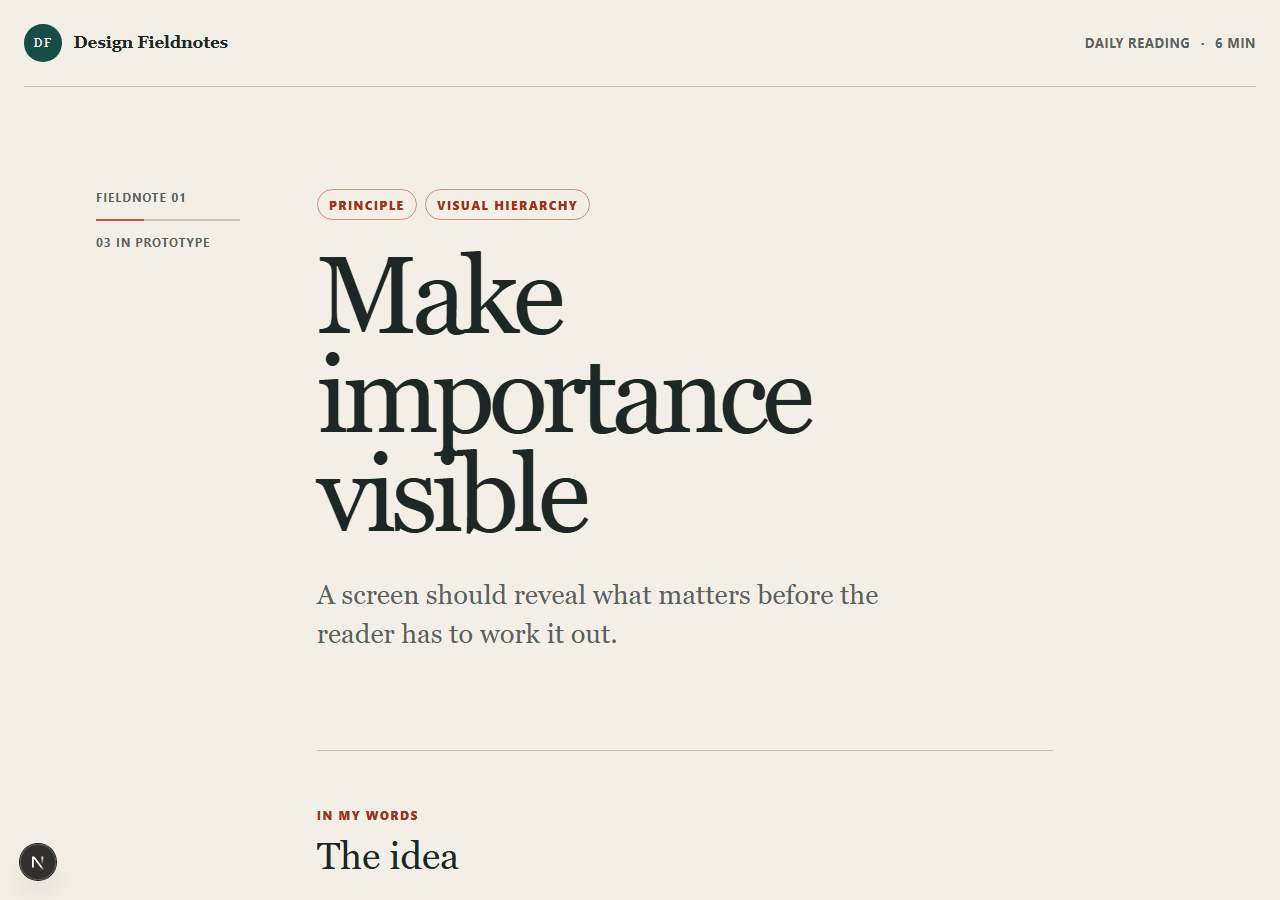
A single-page daily reading session. Each lesson pairs an editorial interpretation ("In my words") with a sourced takeaway ("From the source"), kept in visibly separate sections rather than blended into one voice. Three lessons exist today — visual hierarchy, typography, and contrast/accessibility — each sourced from a real reference (Nielsen Norman Group, Material Design, WCAG 2.2) and each ending in a reflection question and an optional, collapsed practice handoff.
The decision: source and interpretation are structurally separate, not just written separately
The split isn't just a writing discipline — "In my words" and "From the source" are different sections with different visual treatment, and the source gets its own citation card naming the publisher, a linked title, and an explicit note that the lesson text is an editorial interpretation, not the source verbatim.
For a tool built around relearning, that distinction earns its keep for a practical reason: if my interpretation is ever incomplete or wrong, a reader — including future me — should be able to tell that apart from what the source actually said, instead of trusting an unlabeled blend of fact and my current understanding.
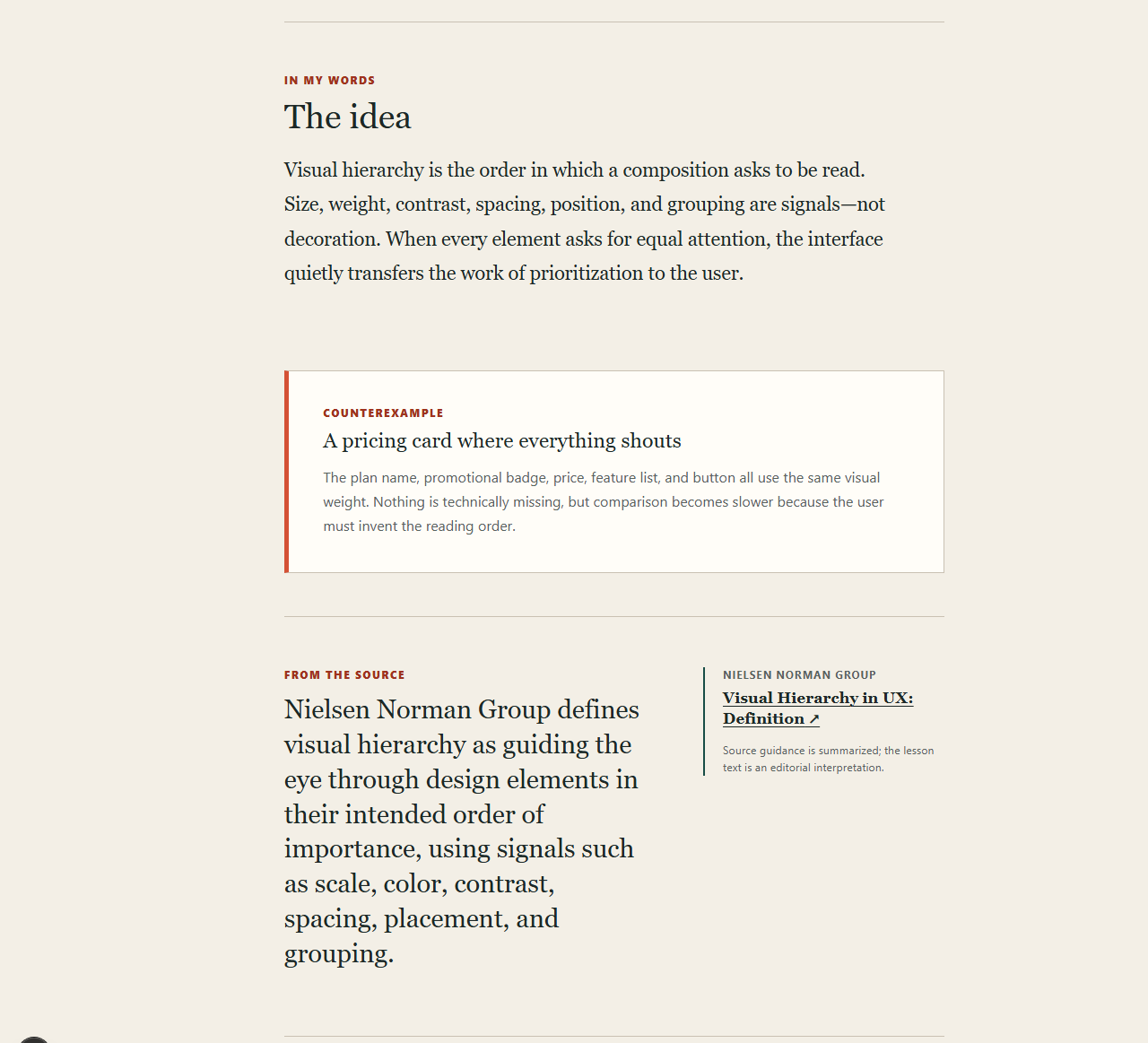
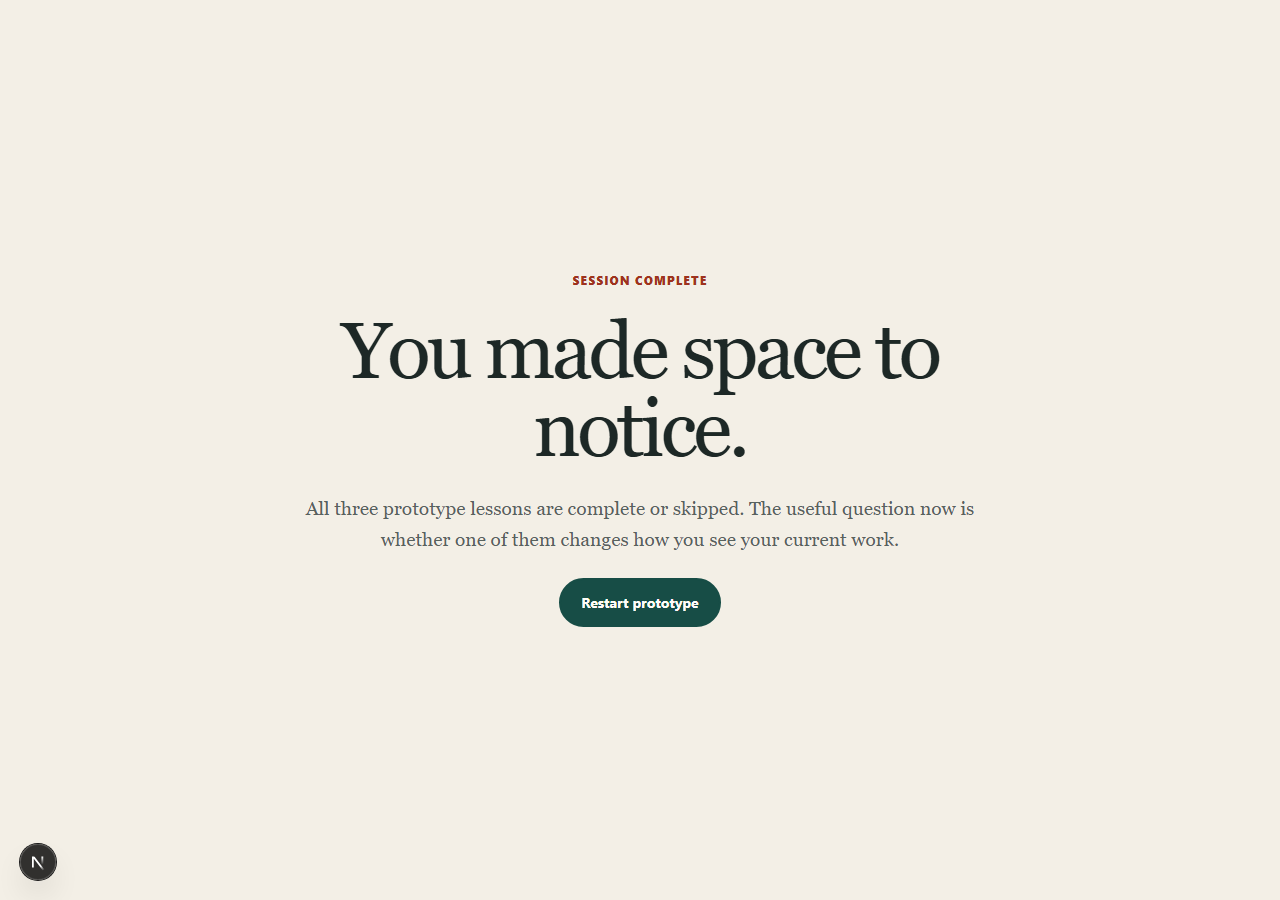
State comparison: an active session vs. a finished one
Scope
What's built: the reading experience above, three hand-authored lessons, and a minimal practice handoff — the only signal it keeps locally is "I need more practice with this concept." Actual exercises and artifacts live in a separate practice system on purpose, not just as a scope boundary: this is a learning experiment, and keeping it separate means mistakes and in-progress work can stay visible elsewhere without this reading tool needing to present itself as a finished, polished thing.
The three topics aren't a deliberately sequenced curriculum — they're what I had source material for first. The plan is to grow this into a real library over time, alongside a gallery of completed practice exercises.
Later phases of the plan include AI-assisted extraction, to help process new source material faster — worth saying plainly rather than leaving it unmentioned: none of that is built or active in this prototype. I see AI as a future tool working alongside the process, not a replacement for the editorial judgment this lesson format is built around.
What's still unknown
I read through all three lessons myself just before writing this — not a substitute for reading them with someone else, but worth noting honestly: they felt appropriately scoped, not overly difficult, and quick enough to complete as a small session. That's the intended use, and at minimum it holds up for its author. Whether it holds up for someone else is the open question.
The honest list: whether a lesson's length feels right to a different reader, whether the source/interpretation split reads as intended, whether the practice handoff helps or is just noise, and whether any of it changes a real decision in an active project. None of that has been checked with anyone but me — see Next Steps.
Next Steps
- Read the three existing lessons with someone other than their author, and record what happens.
- Expand toward a real library of lessons, using the existing reading/practice reference material.
- Build a gallery of completed practice exercises.